
Table of Contents
University of Cologne instruments at AWIPEV
Contact: Kerstin Ebell

AWIPEV is the French-German Arctic Research Base operated by the Alfred Wegener Institute for Polar and Marine Research (AWI) and the French Polar Institute Paul Emile Victor (IPEV). AWIPEV is part of the Ny-Ålesund Research Station. Within the Transregional Collaborative Research Centre TR 172 “ArctiC Amplification: Climate Relevant Atmospheric and SurfaCe Processes, and Feedback Mechanisms (AC)³” ((AC)³), the University of Cologne collaborates with AWI in the long-term observations at the Atmospheric Observatory.
Ny-Ålesund is located on the northwest coast of Svalbard, on the south side of Kongsfjorden. The area is mountainous, featuring seasonal snow cover, a typical tundra system, and glaciers.

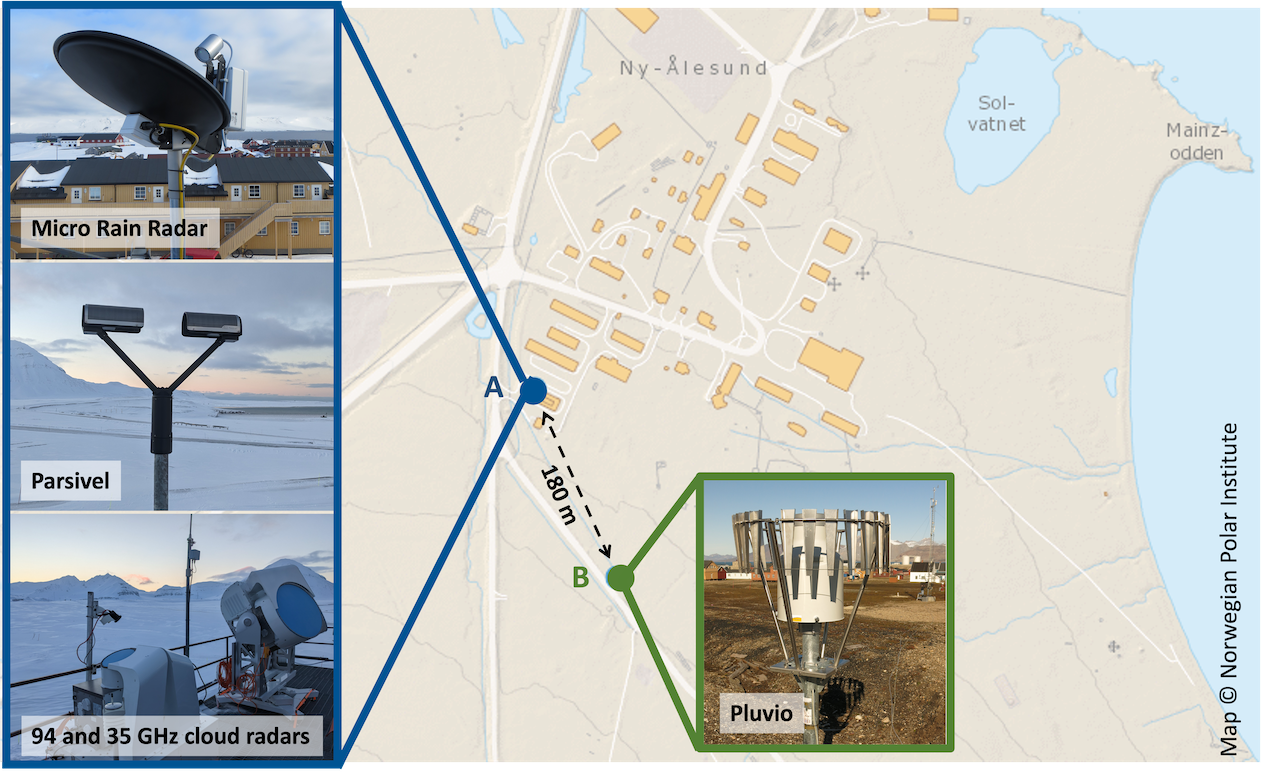
Except for the Pluvio (location B in map), the instruments of the University of Cologne are located on the roof of the AWIPEV Atmospheric Observatory (location A in map). The coordinates of the AWIPEV atmospheric observatory are
- Latitude: 78° 55' 22.8“ N = 78.92327 °N
- Longitude: 11° 55' 15.6” E = 11.92216 °E
- Altitude: 11 m asl (ground) + 8 m (height of roof platform)
Scientific Goals
Within (AC)³, researchers at the University of Cologne, University Bremen, and AWI characterize the thermodynamic structure, clouds, aerosols, and trace gases in the atmospheric column at Ny-Ålesund on a long-term basis. In Cologne, the research focus is on remote sensing of the thermodynamic structure, water vapor, cloud macro- and microphysical properties and precipitation by combining the established observations at AWIPEV and Uni Cologne instrumentation, e.g., a cloud radars, micro rain radar. The ground-based observations at Ny-Ålesund are accompanied by satellite, aircraft, and ship measurements, as well as modeling studies on various scales.
Specific scientific questions are
- To what extent and with which accuracy can we gain insight into the thermodynamic, trace gas, aerosol, and cloud macro- and microphysical properties at Ny-Ålesund?
- What is their impact on the radiation and energy budget throughout the vertical extent from the surface to the lower mesosphere?
- How do Arctic low-level clouds respond to global climate change?
- How representative are the Ny-Ålesund observations across other Arctic sites?
Publications
A list of the project related publications can be found here.
Data quicklook browser
Overview of instruments
If you are interested in data, please contact Kerstin Ebell
| Instrument | Time of operation | Measurements | Related Products |
|---|---|---|---|
| JOYRAD94 94 GHz cloud radar Quicklooks | 10 Jun 2016–26 Jul 2017 | Doppler spectrum moments, Doppler spectrum, 89 GHz brightness temperature | vertical cloud and precip structure, Cloudnet hydrometeor classification and cloud microphysical products |
| 14 Jun 2019–22 Jun 2022 | |||
| 02 Jun 2023– 23 Jun 2026 | |||
| MiRAC-A 94 GHz cloud radar Quicklooks | 28 Jul 2017–08 Oct 2018 | Doppler spectrum moments, Doppler spectrum | vertical cloud and precip structure, Cloudnet hydrometeor classification and cloud microphysical products |
| 23 Jun 2022–03 Mar 2023 | |||
| 24 Jun 2026– ongoing | |||
| NYRAD35 35 GHz cloud radar | 01 Oct 2021–06 Mar 2024 | Doppler spectrum moments, Doppler spectrum, polarimetric variables | in combination with 94 GHz cloud radar, info on ice habit, particle concentration and sizes |
| 25 Jan 2025– Jun 2026 | no measurements since 11 May 2026 | ||
| GRaWAC 167.3/174.7 GHz cloud radar Quicklooks | 25 Jan 2025–04 Mar 2025 | Doppler spectrum moments, Doppler spectrum | water vapor profiles in cloudy and precipitating conditions |
| Micro Rain Radar Quicklooks | 27 Apr 2017–ongoing | Doppler spectrum moments, Doppler spectrum of precipitating particles | snowfall and rainfall rates |
| Parsivel Quicklooks | 29 Apr 2017–22 Jun 2022 | Precipitation particle size distribution and fall velocities | Precipitation type, rain rate (for liquid precip) |
| Parsivel (new instrument) Quicklooks | 23 Jun 2022–ongoing | Precipitation particle size distribution and fall velocities | Precipitation type, rain rate (for liquid precip) |
| Pluvio Quicklooks | 02 Aug 2017–13 Nov 2024 | Precipitation amount/intensity | |
| Pluvio (new instrument) Quicklooks | 21 Oct 2025–ongoing | Precipitation amount/intensity |
Acknowledgements
We gratefully acknowledge the funding by the Deutsche Forschungsgemeinschaft DFG712 (German Research Foundation) - project number 268020496 - TRR 172, within the Transregional Collaborative Research Center “ArctiC Amplification: Climate Relevant Atmospheric and SurfaCe Processes, and Feedback Mechanisms (AC)3”. We deeply thank the AWIPEV station team for technical support, maintenance, and operation of the instruments within the project AWIPEV_0016.